

Switzerland and Italy
The plan was simple – drive through Liechtenstein and Switzerland, admire the highest peaks of the Alps, pop over to France, spend a few days in Italy by Lake Garda and finally recharge our batteries by the sea. And once again, we weren't travelling alone. At Lake Garda, we were joined by our parents, Pavel Jr. and Madla. And things certainly got interesting...
Travel Diary
Day 1
Berchtesgaden
As has become something of a tradition for us, we set off from Prague towards Berchtesgaden. This time, the journey was a little more challenging. The previous night, torrential rain had swept through this part of Austria and Germany, leaving many roads closed. But we made it, back to our favourite spot with its beautiful view. Someone once asked us why we didn't have a television in our campervan. When we explained that we didn't need one because we had a windscreen, they didn't quite understand.
Total: 413 km


Day 2
Königssee
Obersee
In the morning, we moved to the main campsite in Berchtesgaden. It's big, modern and absolutely packed. But it's close to Lake Königssee, which we wanted to visit. So we booked a pitch for one night and headed for the lake.
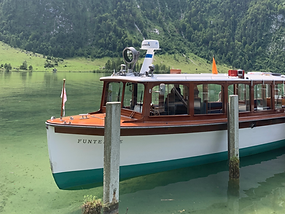
At 190 metres deep, Königssee is Germany's third-deepest lake, and it's almost 6.5 kilometres long. We bought tickets for one of the electric boats and set off on a slow, peaceful cruise. Somewhere halfway across the lake, the boat stopped. A boatman emerged from the cabin carrying a trumpet and announced, "There's a fantastic echo here." He then produced a few rather off-key notes towards the rock face. Afterwards, he pulled out a hat and went around the German pensioners, who happily dropped euros into it. He didn't accept cards.
We reached the far end of the lake and continued on foot. Our destination lay deeper in the valley – Lake Obersee. An iconic Alpine lake with an even more iconic little fishing hut. The lake is less than a kilometre from the boat landing. To reach the hut, you have to walk all the way around the lake along a narrow path that, in places, clings to the rock face.
Nobody played the trumpet on the way back.


Day 3
Großglockner
Kaprun
We headed for Großglockner, Austria's highest mountain. Fortunately, you don't have to walk all the way up. The famous Großglockner High Alpine Road takes you as high as 2,430 metres above sea level, and you'll find yourself stopping every few metres to admire the views. Or to let the engine cool down. The climb is pretty spectacular. If you're travelling by car or motorbike, you can go even higher, up to Edelweißspitze at 2,571 metres. The descent is accompanied by the sounds of overloaded motorhome engines, while the scent of hot brake pads drifts through the fresh Alpine air. Ah, the memories...
We crossed into the neighbouring Kaprun Valley. As the name suggests, it's home to the resort of Kaprun. But we hadn't come for skiing or hiking. In 2000, 150 people died in a fire on a funicular railway running through a tunnel up the mountain, while three more suffocated in the smoke that engulfed the upper station. Today, hardly anything remains of the railway. The tracks leading to the tunnel have been removed, the tunnel has been sealed off and vegetation is slowly reclaiming the hillside. However, a short distance from where the lower station once stood, there's a modest but deeply moving memorial.
We continued west through the Pinzgau Valley and stopped for the night on a farm near Neukirchen am Großvenediger.
Total: 186 km


Day 4
Krimml Waterfalls
Pill
Morning sunshine, green meadows full of cows and somewhere in the distance, the mountain doctor is surely rushing off to another complicated case. Views straight out of a television series. We were in a hurry too, hoping to see the Krimml Waterfalls before the crowds arrived. With their enormous flow of water and a total height of 385 metres, they're among the most beautiful waterfalls in Europe.
We continued along the valley to the town of Pill and prescribed ourselves a quiet, relaxing afternoon.
Total: 87 km



Day 5
Vaduz
Walensee
Another travel dream was coming true. We'd never ventured any further west than Innsbruck before. And now, finally, we were heading for Liechtenstein, towards Vaduz. The road wound its way through the valley until we reached the little town of Feldkirch, where the border runs. The border crossing is basically just a slightly wider road with a car park, where cars drive through and bored customs officers wait for any number plate that isn't Austrian, German, Liechtenstein or Swiss.
Got you! Stop! Where are you coming from? Where are you going? How many of you are there? What are you carrying? How much money do you have? All right then... off you go.
Vaduz is a small town that also serves as the capital of the Principality of Liechtenstein. Everything is packed into a remarkably small area: government institutions, a university, a cathedral and a beautiful yellow parliament building. Overlooking it all from his castle on the hill is Prince Hans-Adam II of Liechtenstein. And to get to know the principality properly, we decided to have lunch in a local restaurant. After just two words, the waitress realised our German wasn't exactly perfect and asked where we were from. As it turned out, she was Slovak and had been living in Vaduz for twenty years. She recommended a local lunchtime classic: cold sausage, chunks of cheese, salad and all these carefully prepared ingredients covered in some mysterious substance. It was certainly an unforgettable culinary experience. Never before had we eaten something that looked and tasted as though someone had already eaten it before us.
We left Vaduz, crossed the Rhine into Switzerland and headed towards Lake Walensee. We decided to spend the night on a small farm in the hills.
Total: 231 km


Day 6
Sumvitg
The elderly lady didn't want a single franc for our overnight stay, but she did offer us her homemade cheeses, yoghurts and milk for sale. When we saw the incredible speed with which she swatted the blowflies gathering around the cheese, we simply couldn't say no. So we ended up spending considerably more than we would have at a campsite. Breakfast came with some unexpected entertainment from a group of BASE jumpers, who leapt off the mountain above us in wingsuits and landed in the meadow right in front of us.
After breakfast, we continued deeper into Switzerland. Our destination was the village of Sumvitg and, more importantly, the Russeinerbrücke – a historic bridge dating from 1857 that spans the gorge of the Russein Valley.
Total: 103 km


Day 7
Andermatt
Furka Pass
Totensee
We planned our next route through the Schöllenen Gorge. People first managed to cross this narrow passage above the River Reuss around the year 1200. According to legend, the only one capable of building a bridge there was the devil himself. That's why the original bridge is called the Devil's Bridge, or Teufelsbrücke. Today, there are three bridges squeezed into this narrow spot: the original bridge, a newer road bridge and a railway bridge. You can also explore a defensive tunnel built by the Swiss army, which was intended to remain the only route through the gorge in the event of an attack. And somehow, there's even room for a large monument carved into the rock, commemorating a battle fought here during the Napoleonic Wars.
We climbed higher and higher out of the valley along winding hairpin bends. The green landscape disappeared far below us, leaving nothing but Alpine tundra all around. We were almost 2,500 metres above sea level, surrounded by lichens... and a hotel with peeling paint. It looked abandoned, although a few cars were parked outside. We stopped, peered inside and discovered a modern café full of customers. We couldn't resist a coffee with an epic view. It could have been even more epic. A heavy oak board, dropped by a member of staff at the bar one floor above, missed Petra by just a few centimetres. With perfect hipster calm, the woman smiled and thanked us for returning it.
Then came more hairpin bends, this time heading downhill. On one of them, we passed a strangely familiar building. Of course! It was the famous hotel from the James Bond film Goldfinger. We pulled into a nearby car park. The hotel itself was closed, but the car park was full. That's because the Rhône Glacier is right next door. Once a majestic glacier stretching all the way down into the valley, it has retreated by 1.3 kilometres over the past 150 years and is now around ten kilometres long. And what's more, it's expected to disappear completely within a few decades. For an admission fee, you can explore the places where the glacier once reached and even venture inside it, through tunnels carved into the ice and glowing with extraordinary colours.
But the day wasn't over yet. We descended into the valley, only to climb another mountain – up to Grimsel Pass.
Total: 78 km


Day 8
Grindelwald
Crans-Montana
Bramois
Camping at over 2,000 metres above sea level brings plenty of unusual experiences. We parked beside Lake Totensee, with magnificent views of the surrounding mountains. While we were having dinner in a nearby restaurant, a cloud rolled in and completely swallowed the entire area in thick fog. The whole thing took about three minutes. Afterwards, we could barely find our way back to the van, and parking on the edge of a steep drop suddenly became a lot more exciting. So much for the views. And to make matters worse, as we drove away, we ran over our beloved little folding stool. May it rest peacefully in the local plastics recycling bin...
Our next stop was the Grindelwald Gorge. A gorge one and a half kilometres long and 300 metres deep, carved out by a melting glacier. A beautiful place full of colours and tourists.
Along the way, we passed the winter resort of Crans-Montana. Since I remembered staying there as a child, we decided to see what it looked like these days. Crowded, extremely expensive – and it wasn't even peak season. We had a quick walk around the centre, got back in the van and continued to Bramois, where we found a small, peaceful, family-run campsite.
Total: 222 km


Day 9
Euseigne
Grande Dixence
Chamonix-Mont-Blanc
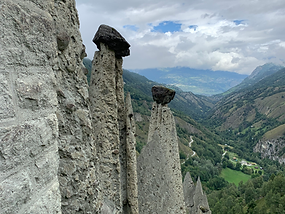
Just above Bramois lies one of Switzerland's most important geological landmarks – the earth pyramids of Euseigne. These formations, reaching up to 15 metres in height, began to take shape at the end of the Ice Age as the glaciers melted. Rainwater and meltwater gradually washed away the softer rock. Large boulders acted like roofs, protecting the material beneath them.
But now it was time to visit the queen of Swiss dams – Grande Dixence. With its crest at 2,365 metres above sea level and a height of 285 metres, it's the tallest gravity dam in the world. A winding road leads to it through the Val d'Hérémence, turning into a series of hairpin bends towards the end of the valley. We parked below the dam and walked to the cable car station, which took us up to the top.
A road runs around the reservoir, passing through numerous tunnels. And inside them, there's a rather special Swiss feature: a light switch with a timer at the entrance. If you take too long, you might find yourself spending the second half of the tunnel with nothing but your phone's torch to light the way.
We crossed the border into France and reached Chamonix in the evening. The town centre, full of winter sports shops and bars, wasn't our main reason for coming. We'd booked tickets for the cable car the following day, which would take us high up into the mountains. Ever since we'd left home, Petra had been absolutely dreading this part of the trip. And yet it was going to be such a highlight! The Aiguille du Midi, a 3,842-metre peak offering unforgettable views of Mont Blanc.
Total: 131 km


Day 10
Aiguille du Midi
Half the crew was so excited they could barely sleep. The other half was so terrified they didn't sleep at all. It wasn't until morning that we saw what awaited us. High above, far beyond the clouds, the Aiguille du Midi towered over us.
We drove to the car park by the lower cable car station and waited for our allocated time slot. In the meantime, we read a few interesting facts about the cable car. Until 2017, it held the record for the greatest vertical rise of any cable car in the world. From the lower station at 1,035 metres, it climbs to an intermediate station at 2,317 metres. Then, without a single supporting pylon, it continues all the way up to 3,777 metres above sea level.
The journey up was merciful. Fog and clouds hid the deep ravines beneath us. It felt more like a lift than a cable car. A lift to the 900th floor. When the doors opened, we stepped into another world – something like a polar research station. Everything was stark, functional, frozen and cold. The air was thin and breathing was harder. All around us, there was nothing but white fog and frost.
This incredible structure, built in 1955 and partly carved into the rock and partly suspended from it, offers not only viewing platforms, observation areas and facilities for visitors, but also a research station studying the effects of low oxygen levels on the human body. Above all, it serves as a starting point for climbers tackling the surrounding peaks, including Mont Blanc.
The lack of oxygen was noticeable. Climbing just one flight of stairs was exhausting, and we occasionally had to stop to catch our breath. Plenty of visitors were feeling unwell, and a few were even begging the cable car staff to let them go back down earlier. Petra particularly appreciated the open metal stairs suspended above two kilometres of absolutely nothing.
Eventually, we got lucky. The clouds parted and Mont Blanc appeared before us. So close, yet so far away. Especially for the groups of climbers we could see making their way towards the summit.
It was worth it!
Total: 148 km


Day 11
Lago di Viverone
That same evening, we returned to Switzerland and then crossed to the other side of the mountains into Italy. This time, we took the tunnel beneath the Great St Bernard Pass. We'd never experienced a border crossing inside a tunnel before, and we'd also forgotten that we were entering the EU again. So here's a special greeting to the little Italian customs officer who nearly smashed up his booth in frustration.
This time, we fell asleep with a view of the Matterhorn. The following day, we moved on to Lake Viverone. Perhaps we were still overwhelmed by everything we'd experienced, but this lake did absolutely nothing for us. Nothing much anywhere, just some strange restaurants with outdoor seating areas covered in plastic sheeting. So we spent the rest of the day relaxing by the van.
Total: 73 km


Day 12
Lago d'Iseo
Another day, another Italian lake. Along the way, our sliding door started squeaking. It turned out that a bolt on its rail had come loose. And since it could no longer be tightened, the mission was clear: stop at a scrapyard in Milan and find a replacement.
We drove through the suburbs, passing various yards full of wrecked cars, looking for anything remotely connected to Mercedes. And we were in luck. Beneath a rusty logo sat a group of rather portly scrapyard dealers. Reluctantly, we stopped. Petra stayed in the van while I went to negotiate. Once I'd explained what I was looking for, the oldest man gestured to a younger one, who called over someone younger still, who in turn summoned an even younger helper. Eventually, a boy of about ten took me by the hand and led me deep into the scrapyard. At the very far end, we stopped beside a pile of scrap metal. The boy shouted something, and a mechanic crawled out from underneath it. "I haven't got that bolt, but try these two. They might fit." The boy then took me back to the boss. When he saw what I was taking, he simply waved his hand. So we gave him two Czech Pilsner beers as a thank-you. Oh, and the bolts didn't fit.
The enormous and expensive campsite by Lake Iseo was fully booked. Luckily. We had to drive a few kilometres further, which led us to a small, pleasant campsite. In fact, its main attraction was that there was hardly anyone there. Our peaceful morning was slightly disturbed by a cleaner who hauled a large television out through a window into the garden and switched on an Italian morning disco show. But as a place to spend the night, it was more than enough.
Total: 195 km


Days 13 – 16
Lago di Garda
We followed the western shore of Lake Garda all the way north to the town of Torbole. We parked at a campsite near the centre and went to collect the keys to the apartment where the rest of the family would be staying for the next four days. Everyone except Madla, of course, who slept with us in the van.
Every day, we went on trips around the lake, went swimming and enjoyed the simple pleasure of not having to be anywhere.
Total: 113 km


Day 17
Lido di Pomposa
We headed to the seaside town of Lido di Pomposa. The drive through the Italian countryside was fairly monotonous. Nothing but flat fields and lorries loaded with freshly harvested tomatoes. We arrived at the two-storey house we'd booked in advance for the family. The Airbnb listing had promised accommodation in a house shared with the owner, but with privacy. We were greeted by Mina, an elderly lady from Milan who only used the house during the summer. She was lovely, spoke nothing but Italian and kept asking where the bambino was. When we explained that he was on his way with his parents, she looked a little confused. We took Madla to a campsite on the edge of town, parked the van and waited for the rest of the family to arrive. They'd been delayed by a spot of sightseeing.
We met at the house that evening. Even from a distance, the participants in this social experiment didn't look particularly happy. Our parents were upset to discover that Mina didn't live upstairs, but downstairs with them. The upper floor was actually a separate apartment belonging to someone else. Pavel Jr. wasn't happy because he didn't have his own room and had to sleep in the hallway behind a curtain next to the boiler. And Mina wasn't happy because the bambino turned out to be nearly forty years old and weigh a hundred kilos.
To be fair, staying with Mina turned out to be lovely. After the initial awkwardness, and with a little help from Google Translate, we spent several enjoyable evenings together. Thanks to a generous supply of slivovitz, our parents suddenly became fluent in Italian and Mina in Czech. She was also out most of the day, returning in the evening with shellfish she'd collected herself. She cooked dinner and was an absolutely wonderful host. We're still in touch with her today.
On the day we were leaving, Mina had a visit from a friend. When the friend saw that we'd packed our bags and were about to go, she quickly called her husband, who apparently wanted something from us. Within minutes, a car came racing down the street and a small, extremely intense man jumped out. It took us a while to realise that he wasn't demanding mafia protection money, but was actually trying to perform a magic trick. So there we stood for twenty minutes, bags in hand, watching him slide a knot backwards and forwards along a broken shoelace. Unforgettable.
On the way, our exhaust fell off.
Total: 248 km


Day 18
Comacchio
Mina recommended that we visit the nearby picturesque town of Comacchio. These "Little Venice" canals are, unlike the real Venice, almost deserted, without streets packed with tourists, touts and fees. Instead, the town is full of cosy cafés and restaurants serving specialities made from eels that live in the surrounding wetlands. They've been catching eels here in the same way since Roman times.
Total: 26 km


Days 19 and 20
Ossiacher See
Traunsee
On our way back to Prague, we spent the nights beside the Alpine lakes of Ossiacher See and Traunsee. Naturally, Madla appreciated these refreshing stops the most after the long drive, as she was the one suffering most from the heat.
From Traunsee, we headed home via Passau. Just before the border, an unmarked police car overtook us. Two older German police officers, both speaking fluent Czech, were looking for migrants and smugglers. All they found in our van was a rather grumpy Madla, who was using her body to conceal our contraband: Italian pasta, olive oil and a well-chewed stick from the beach.
Total: 626 km


